
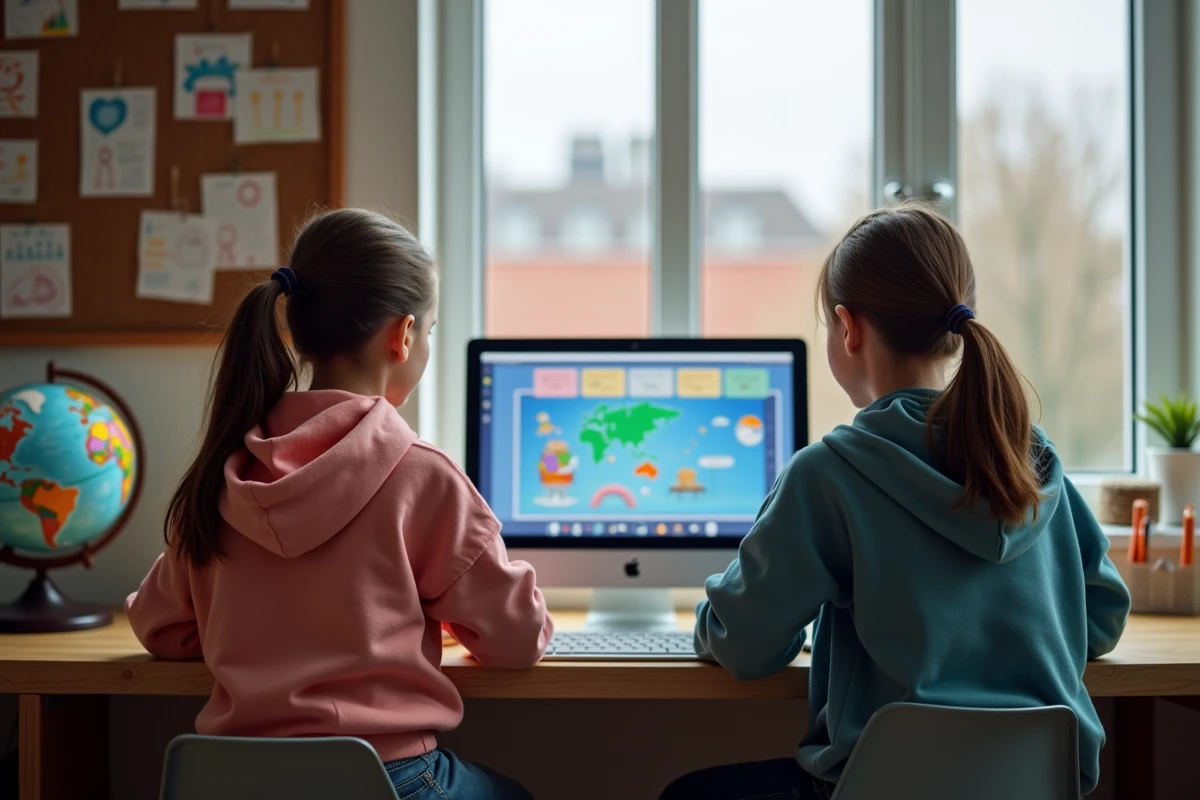
Online resources for children refer to all platforms, applications, and digital content designed to combine school learning and entertainment for ages 3-12. Their common point: to offer interactive activities (games, videos, quizzes) linked to identified educational objectives, whether it be reading, math, or general knowledge.
Education for Responsible Digital Use: An Absent Angle from Usual Lists
Most comparisons of educational websites focus on school subjects. They overlook a growing need: teaching children to navigate the internet safely.
The national program Internet Sans Crainte has enriched its educational pathways in 2023-2024 with new interactive modules aimed at 7-12 year-olds. These modules address concrete topics such as influencers, fake news, or personal data protection. Education for responsible digital use complements traditional school learning, and this type of resource deserves to be integrated into the family’s digital routine just like a math exercise.
Before multiplying subscriptions to private platforms, it is worth exploring children’s content on Une Famille to identify suitable options for each age group.
Free Digital Libraries: Educational Resources Without Advertising
Francophone national libraries and media libraries have significantly strengthened their youth digital portals since 2023-2024. The BNF-Kids portal of the Bibliothèque nationale de France, for example, offers books, comics, and games accessible for free with a simple library card.
The network of Paris media libraries has also updated its youth digital offerings in 2024. A library card provides access to content without advertising or data collection, which is a major advantage compared to advertising-funded platforms.
This free and ad-free model addresses a legitimate concern of parents. Children access resources validated by professionals in books and cultural mediation, in a digital environment designed for them.
What These Portals Offer in Practice
- Digital books and comics viewable on tablets or computers, with selections by age group and theme
- Educational games and quizzes integrated into reading pathways, often designed in partnership with youth publishers
- Online courses and workshops (creative writing, scientific introduction) led by librarians or specialized instructors
The main barrier remains the visibility of these offerings. Few parents know that free registration at a media library also grants access to a digital catalog for children.
Online Educational Platforms: Criteria for Choosing Without Getting Distracted
Faced with the proliferation of online educational games, the risk is to flit between dozens of platforms without any of them being truly engaged by the child. Three criteria allow for effective sorting.
Alignment with the School Curriculum
Some platforms explicitly align their content with the national education programs, from preschool to middle school. Lumni, the public audiovisual portal, structures its resources by grade and subject: videos, quizzes, animated series. A site aligned with the school curriculum facilitates the connection between school and home.
Other sites, more focused on free play, develop transversal skills (logic, reasoning, creativity) without a direct link to a lesson. The two approaches complement each other, but confusing them leads to disappointed expectations.
Business Model and Advertising Exposure
A free site funded by advertising exposes the child to commercial solicitations, sometimes poorly targeted. Public platforms (Lumni, BNF-Kids, media libraries) and some paid tools operate without advertising. Checking this point before allowing a child to navigate alone is a basic precaution.
Child’s Autonomy and Educational Feedback
A good online educational tool provides immediate feedback to the child: correction, hints, progressive scores. This feedback allows the child to work without constant supervision while maintaining motivation. Platforms that only offer exercises without automatic correction quickly lose their appeal.

Educational Videos and Podcasts: Often Underestimated Supplements
Parents spontaneously think of interactive games, but audio and video formats are valuable educational resources in their own right for children. Podcasts, in particular, offer a specific advantage: they do not require a screen.
Several public audiovisual programs target elementary and middle school students with short formats. Educational channels on video platforms cover sciences, history, or languages with animations suitable for young audiences.
- Educational podcasts allow for listening in the car, at bedtime, or during a manual activity, without adding screen time
- Short videos (less than ten minutes) on scientific or historical topics work well as a complement to classroom lessons
- Some SVOD platforms have begun to integrate structured educational sections with downloadable educational sheets to extend viewing with a practical activity
Alternating interactive games, videos, and podcasts diversifies learning modes and reduces fatigue associated with prolonged use of the same type of medium.
The choice of an online educational resource benefits from being guided by a simple criterion: does the child return to it on their own after the first use? A site or podcast that does not inspire this spontaneous desire rarely fulfills its role over time, regardless of the quality of its educational content.