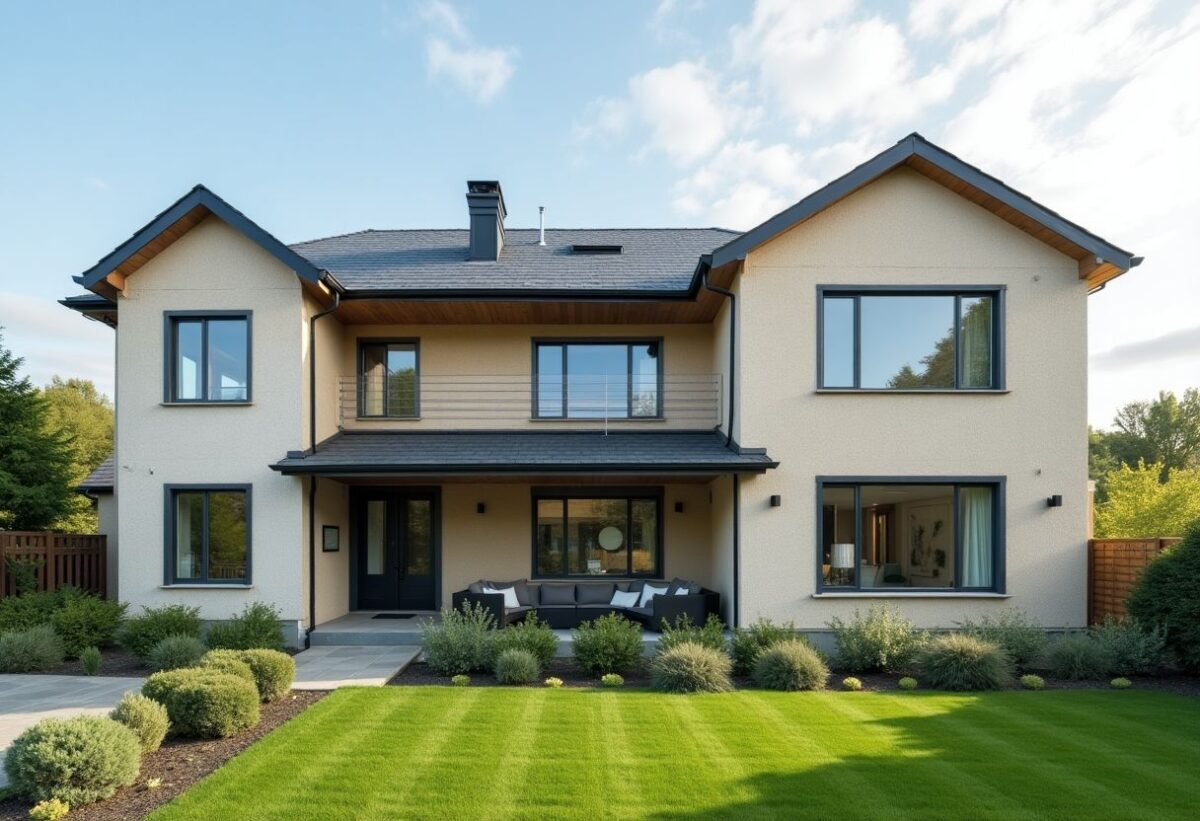
In the face of current environmental and economic challenges, energy renovation of buildings has become a priority. External insulation stands out as an effective solution to improve the energy efficiency of homes. By enveloping the building in an insulating layer, this method significantly reduces thermal losses while protecting existing structures. Not only does it contribute to optimal thermal comfort, but it also helps reduce energy bills and preserve the environment.
The advantages of external insulation
There are many benefits awaiting those who choose external insulation. It offers advantages that go well beyond simple thermal improvement.
- Improved thermal comfort: By minimizing thermal bridges, this technique ensures a stable indoor temperature, both in summer and winter.
- Energy savings: A well-insulated house reduces heating and cooling needs, which lowers energy bills.
- Property value enhancement: A well-insulated home is more attractive on the real estate market and may see its value increase.
- Preserved aesthetics: External insulation allows for facade renovation according to tastes, without affecting the interior of the house.
The different techniques of external insulation
Several methods exist to achieve effective external insulation. Each technique offers its own advantages and is suited to specific situations.
- Coating on insulation: This method involves applying rigid insulation to the facade, covered with a coating. It is appreciated for its ease of application and aesthetic finish.
- Cladding: Used in various contexts, this technique applies a cladding material to a framework fixed to the facade. It allows for easy integration of various facing materials.
- Pre-fabricated cladding: Ready to install, pre-fabricated cladding combines insulation and facing, offering a quick and aesthetic solution for covering buildings.
Potential drawbacks and constraints
As interesting as it may be, external insulation is not without some drawbacks that it is wise to be aware of before embarking on a project.
One of the main obstacles remains the initial cost, often higher than other insulating solutions. However, this investment is quickly recouped thanks to the energy savings achieved. Some administrative constraints may also arise, particularly in terms of urban planning, when external modifications impact the visual aspect of the neighborhood.
The choice of materials must be made wisely to avoid potential humidity or ventilation issues.
Finally, the work can be disruptive, especially if scaffolding needs to be installed.
When to opt for external insulation?
The ideal time to consider this approach depends on several factors. Here are some pointers to determine if it is time to adopt it.
During energy renovation work, external insulation proves to be a relevant solution for those looking to optimize the thermal performance of their home.
External insulation is often considered during facade renovation projects, as it allows for a combination of energy efficiency and exterior beautification.
Homeowners wishing to extend the lifespan of their house while improving its comfort also find it beneficial.
For new constructions, this method ensures from the outset a high-performance envelope that complies with current environmental standards.