
A third-year student receives a studio brief: deliver six variations of armor for a playable character, with technical annotations, in five days. His classmate, focused on illustration, is simultaneously working on a single promotional image intended for the game’s Steam page. Both are drawing, using the same software, and sometimes sharing the same anatomy class. However, their daily lives have almost nothing in common.
Iteration sprint vs. final image: the production pace in concept art studies
The most tangible difference between the two programs is felt in their relationship with time. In concept art, work is done in short sprints. The workshops replicate the functioning of studios: regular stand-ups, daily feedback, successive versions of the same design sent through production tracking tools.
Each visual proposal is a functional draft. It must be readable, coherent with a universe, and above all, modifiable without pain. The image is never the final delivery; it serves as a decision-making support for an art director or game designer.
This pace conditions the reflexes acquired during training. Students learn to produce quickly, not to get attached to a rendering, and to accept that a proposal may end up in the trash after three hours of work. Students who understand the differences between illustration and concept art identify this relationship with time as the first criterion for choosing between the two paths.
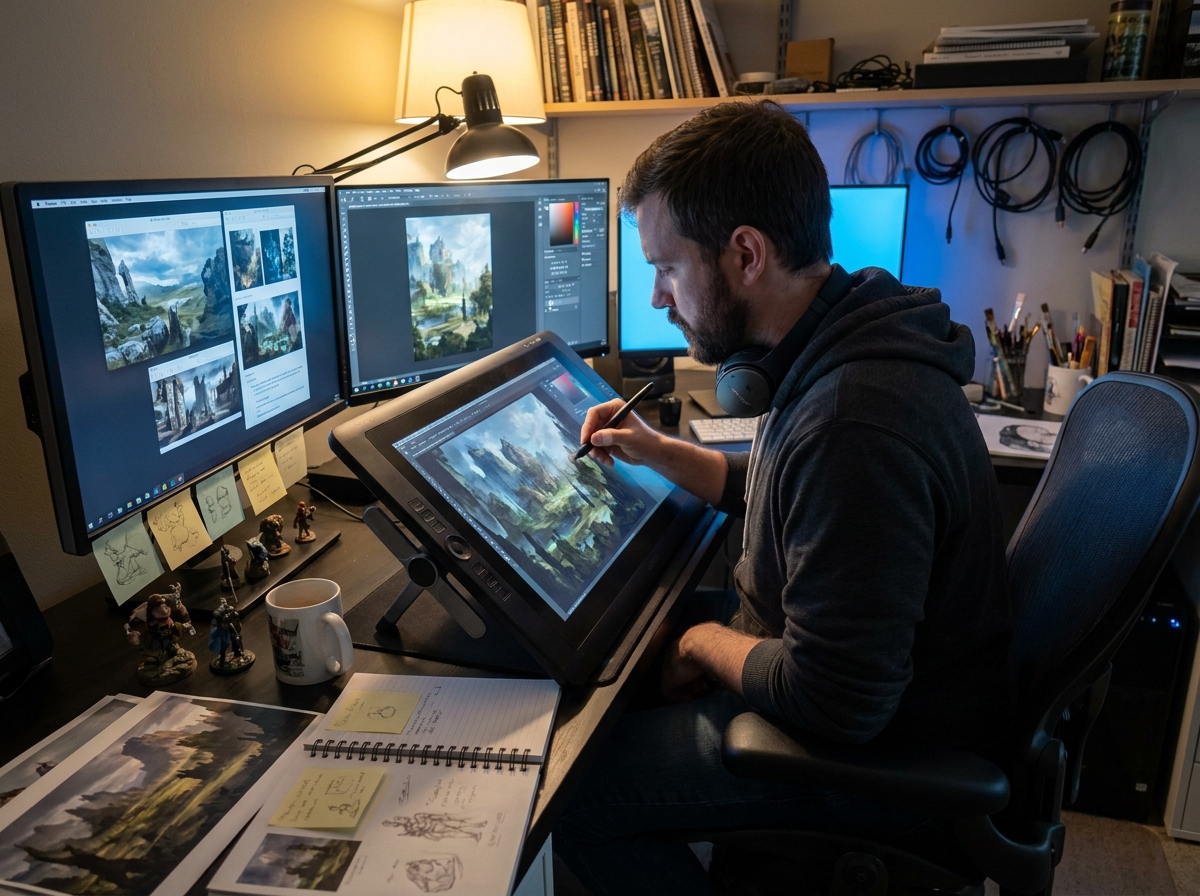
In illustration, the schedule is quite different. An image can take several weeks. The process goes through stages of sketching, roughs, coloring, and then careful finishing. The result will be seen by the public, printed, or displayed online. Every detail matters because the image stands on its own.
Illustrator portfolio or concept artist book: what recruiters really look for
A concept art book and an illustration portfolio do not show the same thing, and the training that prepares for one or the other emphasizes very different deliverables.
Expected content in a concept art book
- Research boards showing several variations of the same subject (character, vehicle, environment), with annotations on proportions, materials, or functionality
- Turnarounds (front, profile, back views) usable by a 3D modeler or animator
- Studies of silhouettes and quick shapes proving the ability to explore a wide range of visual directions in a short time
Recruiters look for the ability to iterate, not the finish. A concept artist who only presents polished images sends a bad signal: they risk slowing down the production pipeline.
What distinguishes an illustration portfolio
The illustrator shows finished narrative images. Each piece tells something, plays with composition, light, and emotion. The recruiter or client evaluates stylistic coherence, mastery of visual storytelling, and the quality of the final rendering.
Field feedback varies on this point, but the recent trend in studio job postings is convergence: many offers now seek a hybrid profile, “Concept Artist / Illustrator.” Training that completely separates the two specialties risks producing profiles too narrow for the current market.
Tools and pipeline in training: Photoshop, ShotGrid, and marketing schedules
The basic software largely overlaps. Photoshop remains the common foundation. Procreate is common for sketching phases. But it is the work environment around these tools that changes.
In concept art, students learn to integrate their work into a collaborative pipeline. This involves naming files according to precise conventions, using versioning and review tools like ShotGrid, and delivering assets in formats usable by other departments (modeling, animation, lighting).
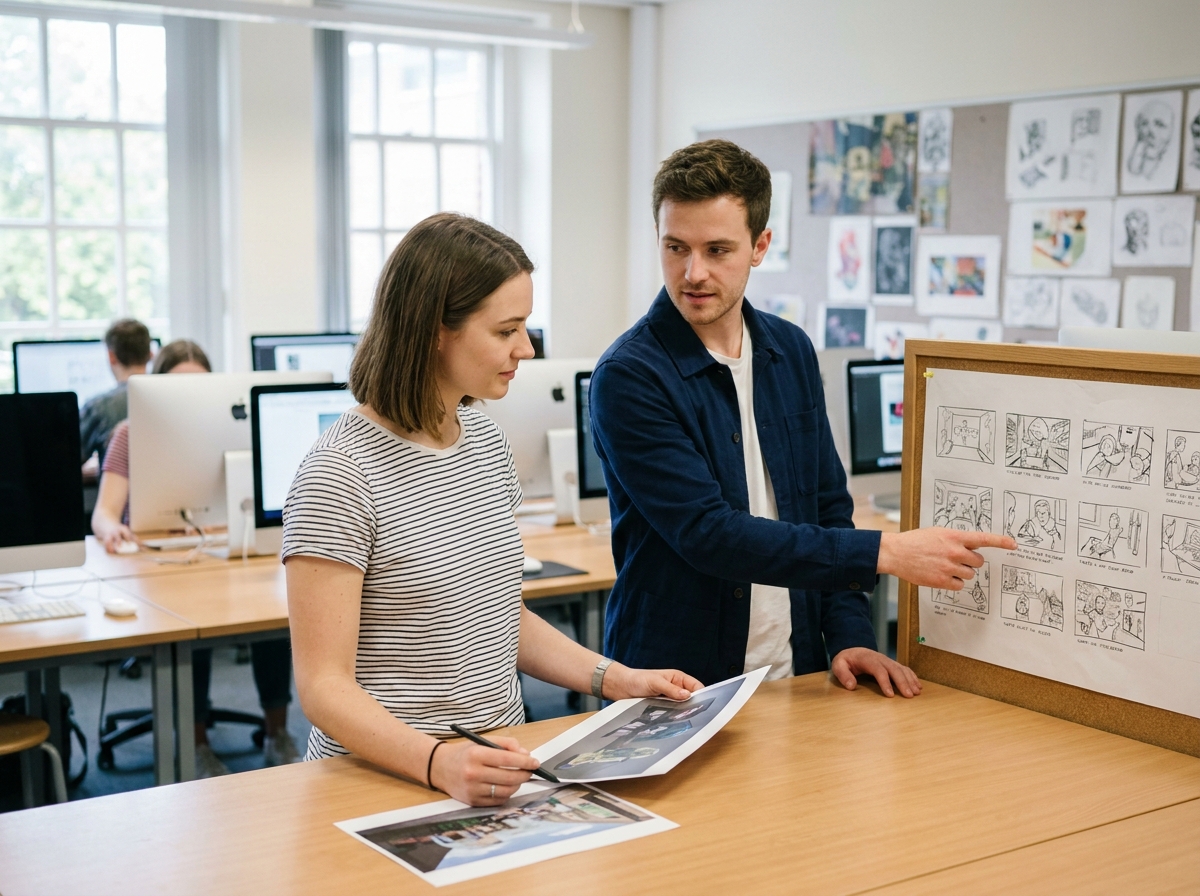
The concept artist delivers components, the illustrator delivers an image. This technical distinction has consequences for the entire organization of courses. Concept art workshops simulate teamwork with distributed roles. Illustration workshops function more as individual projects with client validation milestones.
On the illustration side, the production schedule often aligns with marketing deadlines: book covers for a trade show, launch visuals for a game, pre-order campaigns. The timeline is longer, but the finishing requirements are much higher.
Job opportunities in studios and freelance: where each specialty leads concretely
In recent years, studios have increasingly outsourced concept art to freelancers while hiring illustrators internally to control brand image. Studios like Riot Games or CD Projekt illustrate this trend: much concept art circulates on platforms like ArtStation, while promotional visuals remain produced in-house.
For a student, this distribution has direct implications for the choice of training:
- A concept art-oriented curriculum prepares for freelance work or specialized studio positions, with short missions and a high turnover of projects
- An illustration-oriented curriculum opens more towards salaried positions in visual communication, children’s publishing, or studio marketing
- Hybrid profiles, capable of switching from one production mode to another, are the ones who find work most easily in medium-sized structures
Training that integrates internships in real pipelines (not just academic exercises) provides a measurable advantage for job placement. A student who has already delivered assets in a ShotGrid pipeline or participated in a visual campaign for a launch understands the time and communication constraints that the professional world imposes.
The choice between illustration studies and concept art is not just an aesthetic preference. It is a choice of work pace, type of deliverables, and mode of collaboration. Before applying to a school, spending a week producing ten quick variations of the same subject and then a week on a single narrative image allows one to physically feel which pace suits best.