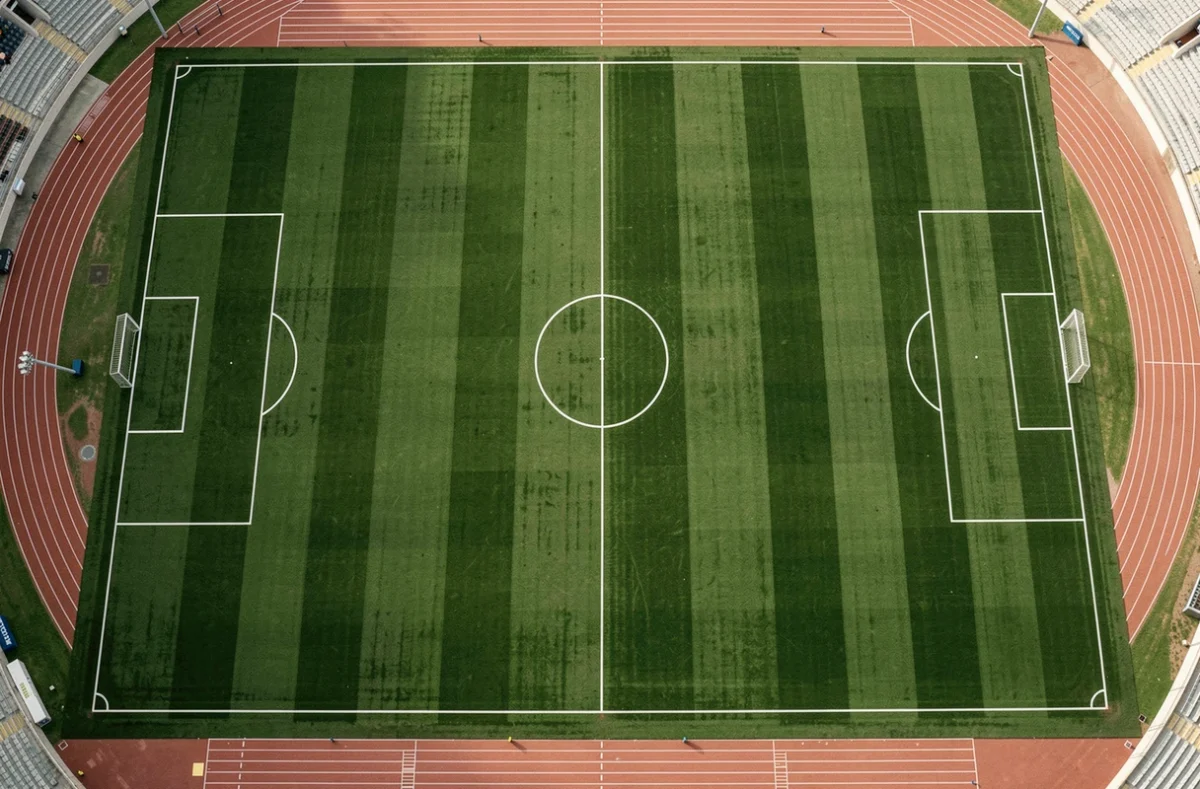
One hectare is equivalent to 10,000 square metres, or a square measuring 100 metres on each side. To visualise this area, people often compare it to a football pitch. The figure commonly quoted is 1.4 pitches per hectare. This ratio is based on a specific pitch size of 105 x 68 m, but the IFAB Laws of the Game allow a much wider range of dimensions, which can significantly change the result.
Playing area or total footprint: two areas, two comparisons
When people say that one hectare is equivalent to around 1.4 football pitches, they are referring exclusively to the playing area: the surface enclosed by the touchlines and goal lines. On a 105 x 68 m pitch, this rectangle covers 7,140 m².
A stadium or sports complex extends beyond this rectangle. The FFF’s facility regulations distinguish between the playing area and the surrounding spaces: run-off areas behind the goals, safety margins along the sides and technical areas. The actual footprint of a developed pitch is considerably larger than the 7,140 m² of the regulation-size rectangle.
So, when comparing a plot of agricultural land or a housing development to a football pitch, it is important to specify which area you mean. One hectare contains around 1.4 times the playing area of a 105 x 68 m pitch, but represents a smaller proportion if you include the surrounding space needed for a complete facility. Understanding the area of a football pitch in hectares makes a difference when assessing a land or sports project.
Football pitch dimensions: why the ratio varies
The 105 x 68 m format is a common benchmark used at most professional stadiums in Europe. It is not a universal rule. The IFAB Laws of the Game specify ranges rather than fixed dimensions.
| Match type | Length (m) | Width (m) | Playing area (m²) | Number of pitches per hectare |
|---|---|---|---|---|
| Common format (105 x 68) | 105 | 68 | 7,140 | ≈ 1.40 |
| International (IFAB minimum) | 100 | 64 | 6,400 | ≈ 1.56 |
| International (IFAB maximum) | 110 | 75 | 8,250 | ≈ 1.21 |
At the minimum dimensions permitted for an international match (100 x 64 m), one hectare contains around 1.56 playing areas. At the maximum dimensions (110 x 75 m), this figure falls to 1.21. The difference between these two extremes is nearly 30%, making any single equivalence misleading.
The lines count in the measurement
IFAB Law 1 states that the lines belong to the areas they enclose. Pitch dimensions are therefore measured to the outside of the markings, not the inside of the visible strips of grass. On a full-size pitch, this has only a marginal effect, but it is a reminder that the comparison should be based on the entire regulation-size rectangle.
Hectares and square metres: useful conversions
The conversion itself is straightforward: 1 hectare = 10,000 m². The hectare is not part of the International System of Units, but it is accepted for use with the system and remains widely used in France for land registration, agriculture and urban planning.
Here are a few comparisons to put the figures into perspective:
- 1 are is equivalent to 100 m², or a square measuring 10 m on each side. One hectare is therefore 100 ares.
- 1 km² is equivalent to 100 hectares. One hectare is one-hundredth of a square kilometre.
- A 105 x 68 m football pitch covers 0.714 hectares, or just under three-quarters of a hectare.
In rural property listings, plots are almost always measured in hectares. For example, a 2-hectare plot (20,000 m²) is equivalent to the area of 2.8 playing areas in the 105 x 68 m format.
The actual area of a stadium: beyond the playing rectangle
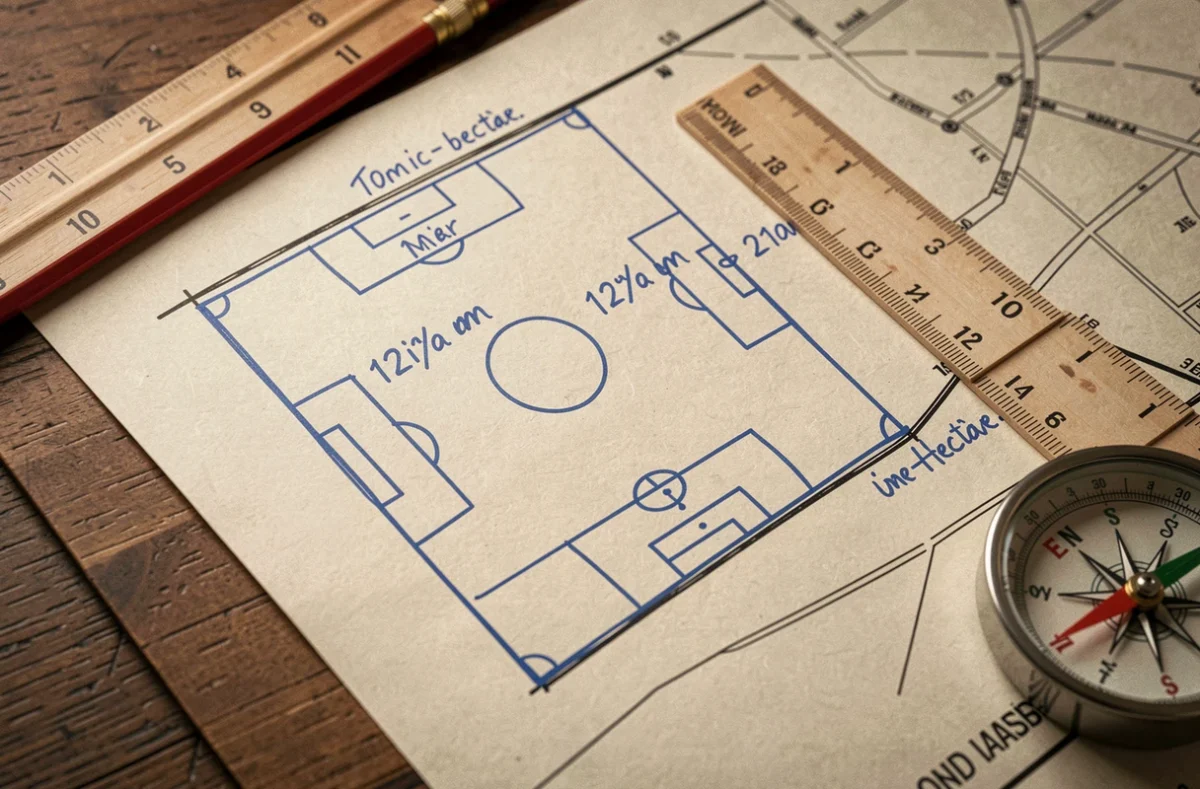
Building a football pitch requires more than just the playing area. Regulation run-off areas, public safety zones, dugouts, technical areas and warm-up zones add considerable space around the rectangle.
FFF regulations set minimum distances between the playing lines and any obstacle or boundary of the venue. These margins vary depending on the level of competition. For a fully equipped pitch with functional surrounding areas, the total land footprint often exceeds one hectare, even though the playing area itself covers only 0.714 hectares.
Keep these three points in mind when comparing hectares with football pitches:
- The ratio of 1.4 pitches per hectare applies only to the playing area of a 105 x 68 m pitch.
- IFAB-approved dimensions make this ratio range from 1.21 to 1.56, depending on the configuration.
- A complete sports facility (pitch, run-off areas and technical zones) uses more land than the regulation-size rectangle alone.
Expressing an area in “football pitches” is still a useful way to visualise it, as long as you know which pitch is being used as the reference. The playing area and the stadium footprint are not the same thing, and confusing the two can distort any land estimate or project planning.