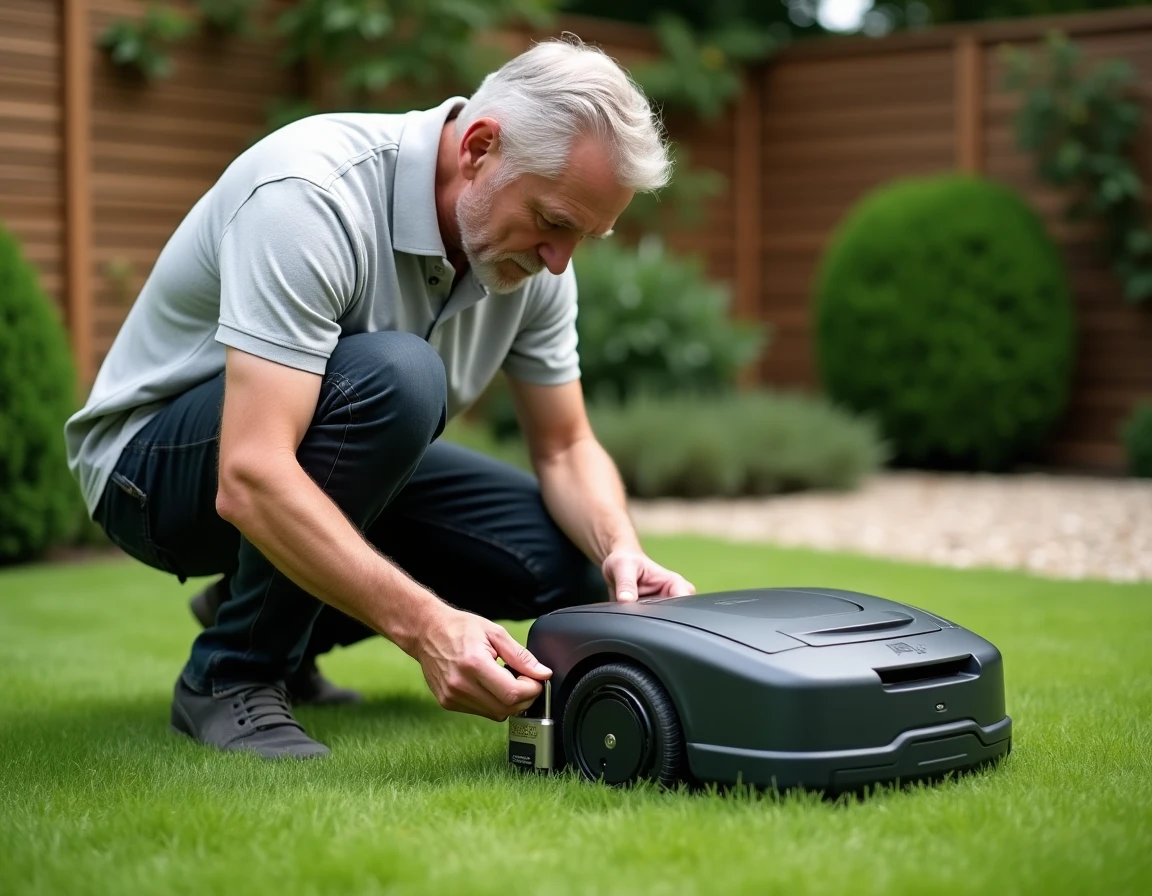
A lawnmower robot left unprotected on its charging station remains an easy target: a simple arm movement is enough to lift it and take it away. The embedded software devices (PIN code, sound alarm) slow down an opportunist, but do not prevent a planned theft. The real question is about the security architecture you deploy around the machine, not just what the manufacturer integrates as standard.
Home Automation Integration and Automated Security Scenarios for Lawn Mower Robots
Open home automation platforms like Home Assistant allow the lawnmower robot to be included in an overall security perimeter. The idea is not to double alerts, but to create chain reactions that cannot be achieved with just the manufacturer’s functions.
A typical scenario triggers both the outdoor camera and spotlight as soon as the robot is moved outside its programmed mowing time. The push notification then combines the garden’s perimeter alarm and the robot’s abnormal movement signal. Some proprietary hubs also offer forced shutdown of the robot as soon as the perimeter alarm is activated.
This level of integration assumes that the robot exposes an API or a compatible protocol (MQTT, REST). Recent models from Husqvarna, via their Connect platform, and several competing ranges offer this possibility. Check compatibility before purchasing if you rely on this type of defense.
Choosing a theft protection for lawnmower robots that is suitable requires combining physical protection and software layers, as neither is sufficient on its own.
Third-Party GPS Trackers and Post-Theft Geolocation of Lawn Mower Robots
The GPS integrated by the manufacturer remains linked to the proprietary application. A thief who resets the firmware or disables the network module cuts off the factory geolocation. Since 2024, security accessory manufacturers have launched GPS/4G or LTE-M trackers dedicated to lawnmower robots, independent of the manufacturer.
These compact modules fit inside the robot’s casing or attach under the chassis. They operate on their own SIM card and transmit the position in real-time via a separate application. The key technical points to remember:
- Reduced format, designed not to interfere with the mower’s sensors or exceed the casing dimensions
- Real-time alerts on smartphone in case of zone exit (geofencing) or prolonged lifting
- Travel history available afterwards, facilitating location by law enforcement in case of theft
- Battery life of several weeks on an internal battery, independent of the robot’s battery
The main advantage is the persistence of the signal even after the robot is reset. The thief must find and physically remove the tracker, which requires careful disassembly. We recommend hiding the module in an area that is not accessible without tools.
Physical Anchoring of the Charging Station and Anti-Theft Cable
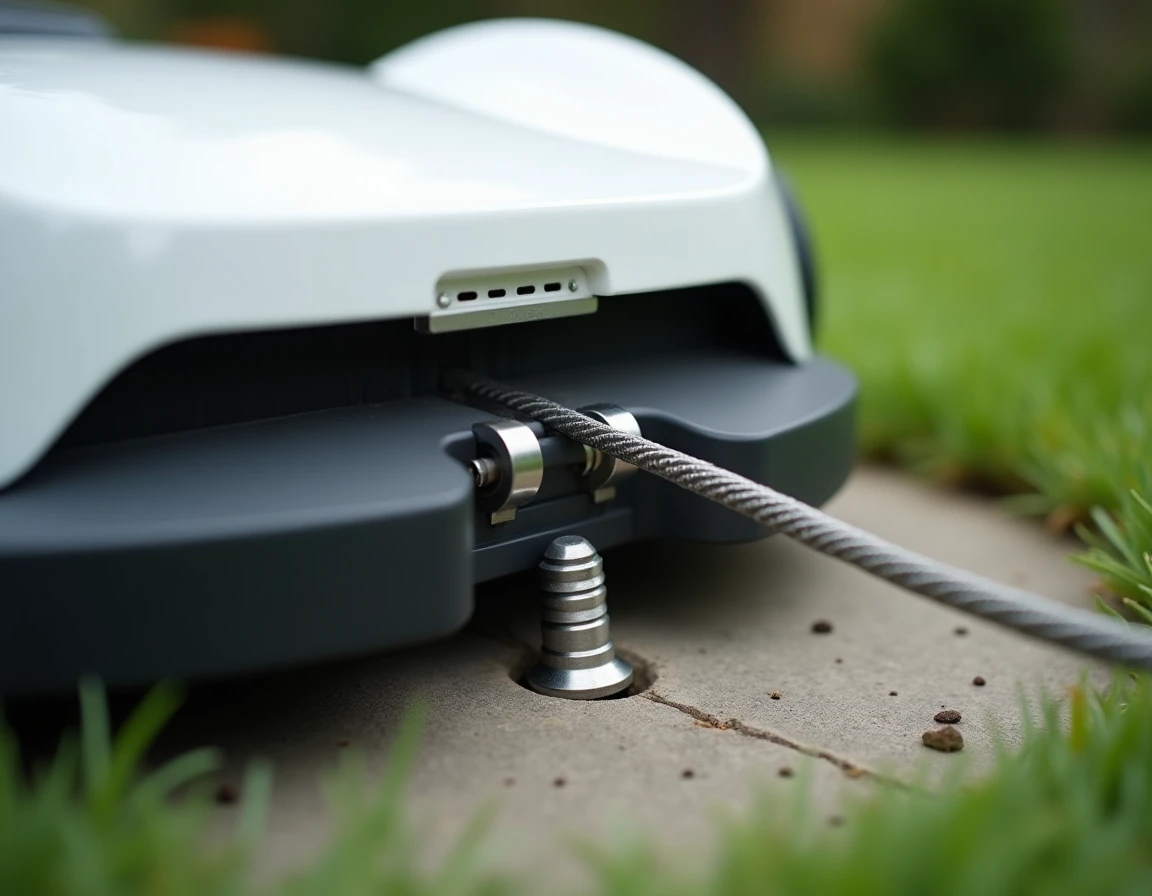
Securing the charging station to the ground with security screws or concrete anchors prevents group theft (robot and station). A thief who takes the station makes the robot much easier to reconfigure with another dock. An unanchored station is an invitation for complete system theft.
The coated steel anti-theft cable, looped between the robot and a fixed point (sealed ring, metal post), adds a mechanical constraint. Its diameter must exceed 8 mm to withstand a standard bolt cutter. Some manufacturers offer dedicated kits with tubular key locks, which are more resistant to picking than standard pin locks.
The combination of station anchoring and anti-theft cable creates a delay in extraction incompatible with discreet theft. We observe that the majority of thefts occur in less than two minutes, during a time when the garden is not monitored. Every additional second imposed on the thief increases the risk that they will abandon.

Home Insurance and Reporting Lawn Mower Robot Theft
The general terms of home insurance have evolved since 2023 regarding coverage for lawnmower robots. Several major insurers now specify the status of these devices in outdoor theft guarantees. The point of friction remains the compensation ceiling for items located outside the main building.
Check if your contract covers motorized items in the garden and what deductible applies. Some contracts require that the robot be stored in a locked shed overnight for the theft guarantee to be effective. This clause radically changes the daily management of the device.
In case of theft, the standard procedure requires filing a complaint, often possible online via the Ministry of the Interior’s platform. Keep the purchase invoice, the serial number, and, if available, screenshots of the last GPS route. These elements expedite the processing of the compensation file.
Hierarchy of Protections: What Really Prevents Theft
Not all layers of security are equal. The integrated PIN code and sound alarm are entry-level barriers. A thief knows them, understands that they have a few seconds before the sound attracts attention, and that a hardware reset can neutralize the software lock.
The realistic hierarchy, from most effective to least effective:
- Physical anchoring of the station and steel anti-theft cable: imposes a tool and time, two constraints that the thief cannot control
- Concealed third-party GPS/4G tracker: does not prevent theft but allows recovery, which deters resale
- Home automation integration (camera, spotlight, combined notification): transforms the garden into an actively monitored zone
- Manufacturer’s PIN code and alarm: slow down an opportunist, insufficient against a targeted theft
Physical protection remains the most difficult link to bypass. Technology adds detection and traceability, but it is the mechanical obstacle that turns a quick attempt into a risky operation. An anchored, tracked robot integrated into a home automation system accumulates defense layers coherently, without unnecessary redundancy.